Value Categories
Value Categories
General
- each expression is characterized by two independent properties: a type and a value category
- each expression has some non-reference type, and each expression belongs to exactly one of the three primary value categories: prvalue, xvalue, and lvalue
- there are also mixed categories which aggregate the primary ones:
- lvalues and xvalues compromise glvalues (Generalized Lvalue)
- xvalues and prvalues compromise rvalues
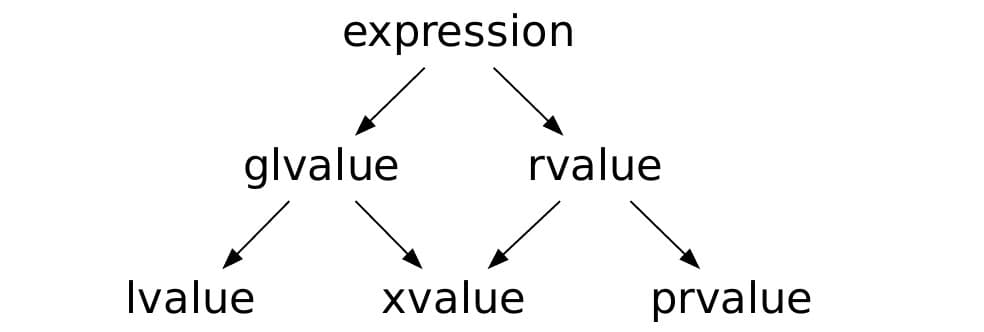
For detailed information about categories check cpp reference
Basic Categories
lvalues
- address of an lvalue may be taken by built-in address-of operator (&)
- modifiable lvalue may be used as the left-hand operand of the built-in assignment and compound assignment operators
- even if the variable type is rvalue reference, the expression consisting it's name is lvalue
- function call which return type is lvalue reference, is lvalue
xvalues (eXpiring)
- function call which return type is rvalue reference to object (like
std::move), is xvalue - any expression that designates a temporary object, after temporary materialization (since C++17)
prvalues (Pure Rvalues)
- cannot be polymorphic or have incomplete type
- there are mainly literals and results of simple expressions
Mixed Categories
glvalue = lvalue + xvalue (Generalized Lvalue)
- glvalue may be implicitly converted to a prvalue with lvalue-to-rvalue, array-to-pointer, or function-to-pointer implicit conversion
- may be polymorphic or have incomplete type
rvalue = xvalue + prvalue
- address of an rvalue cannot be taken by built-in address-of operator
- rvalue can't be used as the left-hand operand of the built-in assignment operator
- rvalue may be used to initialize an rvalue reference, in which case the lifetime of the object identified by the rvalue is extended until the scope of the reference ends
- when used as a function argument and when two overloads of the function are available, one taking rvalue reference parameter and the other taking lvalue reference to const parameter, an rvalue binds to the rvalue reference overload
